


3PE, 3PP and FBE are the dominant external anti-corrosion coatings for buried and subsea oil, gas and water transmission pipelines. Many pipeline engineers and procurement teams struggle to pick the proper coating system, since no single option fits all field conditions. The selection is not based on preference, but on a set of engineering critical factors.
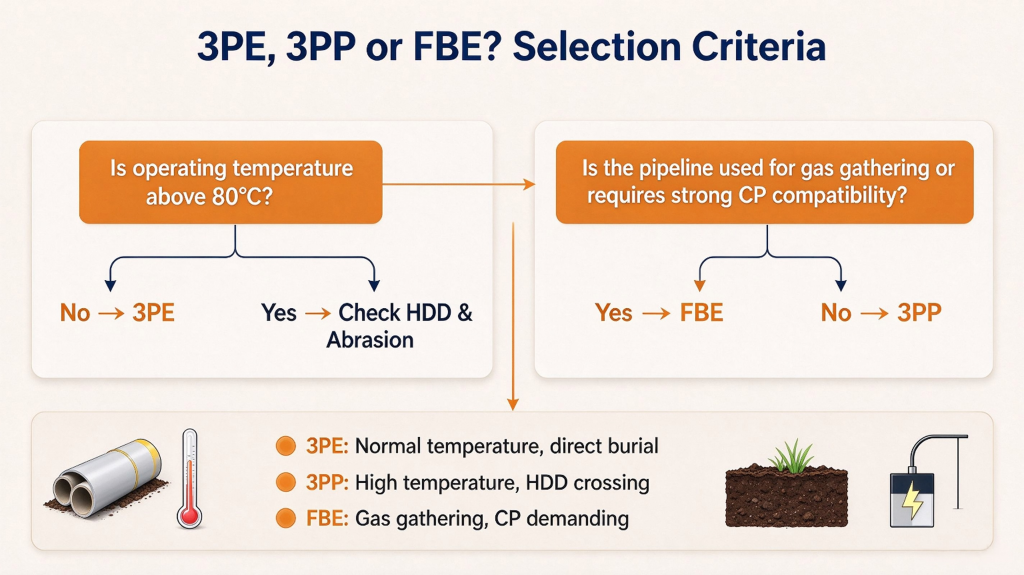
1. Continuous Operating Temperature (The Top Priority)
Temperature is usually the decisive factor.
- 3PE polyethylene coating is suitable for continuous service up to 80°C. Beyond this limit, polyethylene will soften, peel strength drops sharply, and the risk of cathodic disbondment rises significantly. It cannot be used for hot crude pipelines.
- 3PP polypropylene coating supports continuous operation up to 110°C, with short peak temperature reaching 130–140°C. It is the primary choice for high-temperature media.
- Standard FBE normally works up to 110°C; modified high-temperature FBE grades can be specified for special high-temperature designs.
2. Installation Method & Mechanical Abrasion Risk
The construction scheme directly affects mechanical damage risk.
- Direct burial in ordinary soil: 3PE delivers excellent cost performance.
- HDD horizontal directional drilling, river crossing, rocky backfill: heavy friction and scratching are expected. 3PP has superior abrasion resistance, so it is widely recommended for crossing sections. Standard 3PE is easy to tear during long pullback.
- FBE is thinner. It performs well where high impact and abrasion are not major concerns, such as small-diameter gathering lines.
3. Soil Environment & Corrosivity
Aggressive soil brings different challenges:
- Low to moderate corrosive soil: 3PE is stable and reliable.
- High resistivity, acidic soil, sulfate-rich or sour soil environment: coating compatibility with cathodic protection becomes vital. FBE features good CP compatibility, while 3PE and 3PP must pass strict cathodic disbondment tests to meet project requirements. For sour service, coating alone cannot prevent corrosion; the base pipe material and CP system must be matched together.
4. Compatibility with Cathodic Protection (CP)
Coating and cathodic protection work as a combined protection system, not independent. Cathodic disbondment test is the core evaluation index. When coating has defects, CP voltage may lift the coating from the steel substrate. FBE generally shows excellent resistance to cathodic disbondment. Multi-layer polyolefin systems (3PE / 3PP) require qualified test results under project specified temperature and duration before approval. Improper matching will shorten the whole pipeline service life.
5. Project Specification, Thickness and Budget
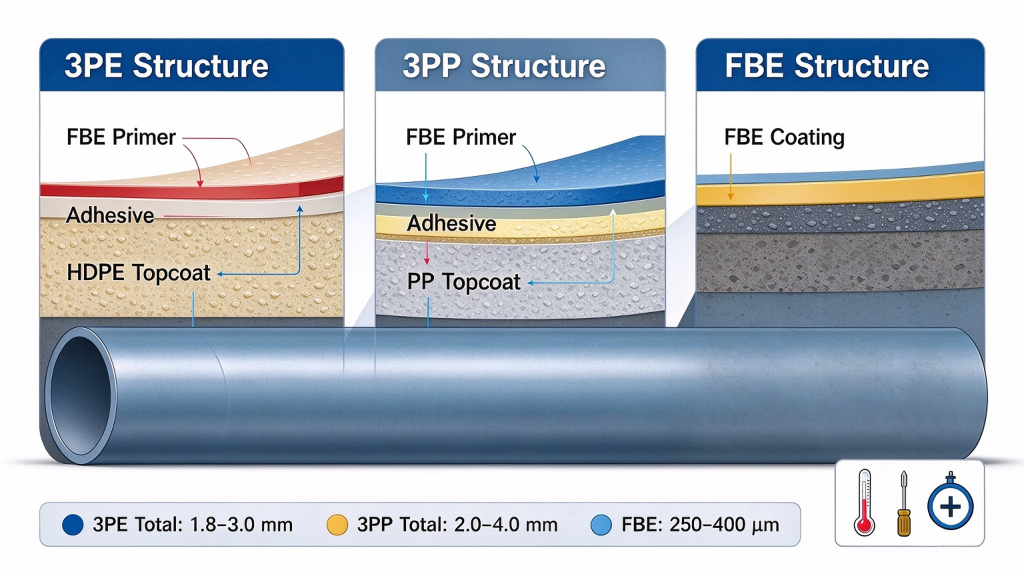
- 3PE: moderate total thickness (1.8–3.0 mm), most economical for large-volume long-distance pipelines.
- 3PP: thicker coating (2.0–4.0 mm), higher raw material and application cost.
- FBE: thin coating (250–400 μm), lower material cost but stricter surface blasting requirement.
When te project has tight budget but normal temperature and ordinary soil, 3PE is the mainstream solution. High-temperature and HDD crossing projects have to accept higher cost for 3PP.
6. Field Joint Repair Maintainability
Field girth weld repair is another practical factor. Each coating system has its matched repair materials: heat-shrinkable sleeves for 3PE/3PP, liquid epoxy for FBE. Mixed incompatible repair materials will cause early failure at joints. If local construction teams are only familiar with one repair process, this factor should also be considered.
Summary
To simplify the selection logic:
Normal temperature, direct burial, cost control → 3PE
High operating temperature, HDD crossing, heavy abrasion → 3PP
Gas gathering line, strict cathodic protection design, small diameter → FBE
Before finalizing your coating specification, provide operating temperature, soil corrosivity, installation method and CP design requirements. We can offer compliant coating solutions and coated pipe quotation according to ISO 21809, DIN 30670 / 30678 and NACE standards.