


Introduction
Welded carbon steel pipes are the most widely used solution for oil & gas gathering, transmission, water supply, piling and structural works. Three main types dominate the market: ERW (Electric Resistance Welded), LSAW (Longitudinal Submerged Arc Welded) and SSAW (Spiral Submerged Arc Welded, also called HSAW).
Many buyers, especially for API 5L pipeline projects, get confused about their seam shape, production logic, pressure rating and suitable scenarios. This article explains how they are made, key differences, inspection requirements and practical selection advice for your tender or procurement.
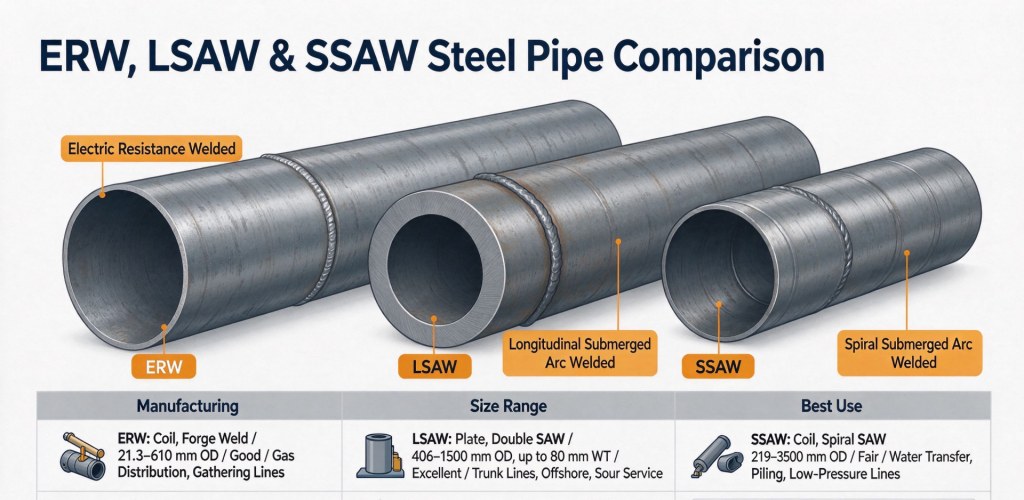
1. ERW Pipe (HF-ERW / HFW)
Full name: Electric Resistance Welded Pipe ERW pipe is formed continuously from hot rolled steel coil. The strip edges are heated by high-frequency resistance current and forged together under pressure. No welding wire or flux is added during welding. A local seam annealing treatment is normally applied to eliminate weld hardening and residual stress for API 5L PSL2 grade.
- Seam: Single straight longitudinal seam
- Raw material: Hot rolled coil
- Typical OD range: 21.3 mm – 610 mm (NPS ½ ~ NPS 24)
- Wall thickness: 2 mm – 20 mm
- Standards: API 5L PSL1 / PSL2, ASTM A53, ASTM A135
- NDT: 100% UT on weld seam for PSL2, hydrostatic test, eddy current test optional
- Advantages: High dimensional accuracy, fast production, competitive price, stable quality for medium pressure
- Limitations: Limited maximum diameter, not suitable for ultra-thick wall
- Typical applications: City gas distribution, oil gathering lines, water pipelines, scaffolding, mechanical and structural pipes. Qualified normalized PSL2 ERW can be used for sour service under NACE MR0175 requirements.
2. LSAW Pipe
Full name: Longitudinal Submerged Arc Welded Pipe LSAW starts from single heavy steel plate instead of coil. The plate is pressed into tubular shape by UOE, JCOE or HME forming process, then welded by double-sided submerged arc welding with welding wire and flux. Mechanical expansion is carried out after welding to control roundness and residual stress.
- Seam: Single straight longitudinal seam
- Raw material: Steel plate
- Typical OD range: 406 mm – 1500 mm
- Wall thickness: 6 mm – 80 mm
- Standards: API 5L PSL2, DNV, ISO 21809
- NDT: UT + RT on weld, hydrostatic test, Charpy V-notch impact test mandatory for critical service
- Advantages: Excellent toughness, heavy wall available, low residual stress, reliable for high-pressure, long-distance trunk lines and offshore projects
- Limitations: Higher cost, slower delivery
- Typical applications: Long-distance crude oil & natural gas trunk pipelines, offshore pipelines, risers, heavy-wall foundation piles,finery process piping. It is the preferred option for sour service and high-risk transmission lines.
3. SSAW Pipe (Spiral)
Full name: Spiral Submerged Arc Welded Pipe SSAW is also made from hot rolled coil. The strip is fed at an angle, forming a spiral tube, then welded by double-sided submerged arc welding. The weld runs helically along the pipe body.
- Seam: Continuous spiral / helical seam
- Raw material: Hot rolled coil
- Typical OD range: 219 mm – 3500 mm
- Wall thickness: 5 mm – 25 mm
- Standards: API 5L PSL1, ASTM A252
- NDT: UT / RT on spiral seam, hydrostatic test
- Advantages: Ultra-large diameter can be produced economically, flexible sizing, good material utilization
- Limitations: Longer weld length, higher ovality risk, generally not recommended for high-pressure sour gas trunk lines
- Typical applications: Large-diameter water transmission, drainage, bridge and port piling, low-pressure fluid pipelines, civil structural pipes.
Quick Comparison
| Item | ERW (HF-ERW) | LSAW | SSAW |
| Weld type | Straight seam, resistance forge weld, no filler | Straight seam, double-sided SAW with wire & flux | Spiral/helical seam, double-sided SAW |
| Raw material | Hot rolled coil | Steel plate | Hot rolled coil |
| Main OD | 21.3–610 mm | 406–1500 mm | 219–3500 mm |
| Wall thickness | Thin-medium (≤20 mm) | Medium-heavy (up to 80 mm) | Medium (≤25 mm) |
| Dimensional tolerance | Very tight | Tight after expansion | Moderate |
| Weld length | Short | Short | Longest |
| Pressure suitability | Medium-high | High | Medium-low |
| Cost | Lowest | Highest | Medium |
| Preferred standard | API 5L PSL1 / PSL2 | API 5L PSL2 | API 5L PSL1 |
How to Choose Between ERW, LSAW and SSAW
- Small & medium diameter (≤610 mm), medium pressure, budget sensitive: Choose PSL2 ERWwith seam annealing and 100% UT. Ideal for gas distribution and oil gathering networks.
- Large diameter, thick wall, high pressure, long-distance trunk, offshore or sour H₂S service: Choose LSAW. This is the mainstream specification for Sonatrach, major international oil operators.
- Ultra-large diameter, low pressure, water transfer or piling: Choose SSAWfor cost saving. It is not recommended for high-pressure hydrocarbon trunk lines unless specially approved by the client.
Common Misunderstandings
- Myth: Straight seam pipe is always better than spiral seam. Fact: SSAW is fully qualified for its designed low-pressure service. The key is matching pipe type to design pressure and medium, not only seam shape.
- Myth: All ERW cannot be used for sour service. Fact: Normalized API 5L PSL2 ERW meeting NACE MR0175 is acceptable for qualified sour gathering lines.
- Myth: LSAW = SSAW. Fact: LSAW is plate-based straight seam; SSAW is coil-based spiral seam, different forming and stress characteristics.
Surface Coating Compatibility
All three pipe types can be coated with FBE, 3PE, 3PP external anti-corrosion coating according to ISO 21809 and DIN standards. The coating performance mainly depends on surface preparation, heating and coating process, not the pipe forming method.
Conclusion
ERW, LSAW and SSAW are all mature welded pipe solutions, each designed for specific working conditions. When you prepare RFQ or tender documents, confirm design pressure, operating temperature, H₂S content, diameter and required NDT scope first. Our team can supply all three pipe grades with EN 10204 3.1 MTC, third-party inspection (SGS, BV, TÜV) and complete anti-corrosion service.