


Introduction
When selecting oil well casing, the connection type is just as important as the pipe size, steel grade, and wall thickness. A suitable casing connection helps transfer axial loads between pipe joints and contributes to the integrity of the casing string.
Three commonly used API casing connections are STC (Short Thread and Coupling), LTC (Long Thread and Coupling), and BTC (Buttress Thread and Coupling). Each has a different thread design and is suited to different operating requirements.
Understanding the differences between STC, LTC, and BTC casing connections can help drilling contractors, oilfield equipment distributors, and procurement professionals specify the right products for their projects.
In this guide, we explain how these three connections differ in design, strength, sealing performance, and typical applications.
1. What Is an STC Casing Connection?
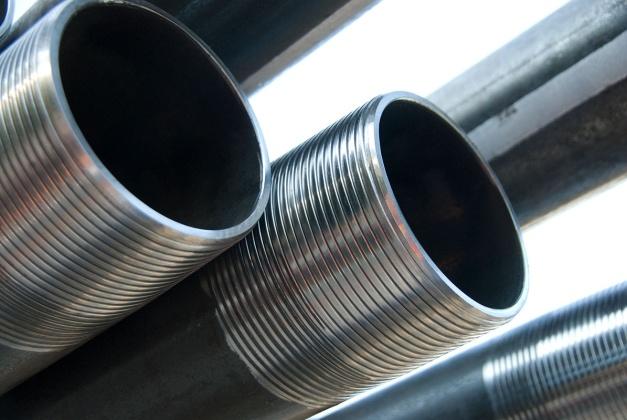
STC stands for Short Thread and Coupling, commonly referred to as short round-thread casing.
STC is a threaded-and-coupled connection used to join casing joints in oil and gas wells. The pipe ends have external threads, while an internally threaded coupling connects adjacent joints.
Key Features of STC Casing
- Thread profile:Round thread.
- Thread pitch:Typically 8 threads per inch.
- Connection design:Shorter thread engagement than LTC.
- Typical advantage:A relatively simple, economical connection design.
- Typical application:Casing strings where the specified connection capacity meets the expected loading conditions.
STC connections are commonly considered for applications that do not require the greater thread engagement associated with LTC or the buttress thread profile of BTC.
However, STC should not automatically be considered suitable for shallow wells or low-pressure wells. Connection selection must account for the actual well design, pipe dimensions, material grade, and anticipated loads.
2. What Is an LTC Casing Connection?
LTC stands for Long Thread and Coupling, also known as long round-thread casing.
Like STC, LTC uses a rounded thread profile and a separate coupling. Its longer threaded engagement provides a different connection geometry and can offer greater joint tensile capacity than a comparable STC connection, depending on the specified pipe dimensions and grade.
Key Features of LTC Casing
- Thread profile:Round thread.
- Thread pitch:Typically 8 threads per inch.
- Connection design:Longer thread engagement than STC.
- Typical advantage:Greater potential tensile capacity than a comparable STC connection.
- Typical application:Casing stringsquiring additional joint strength within the limits of the specified connection.
LTC is often selected for conventional oil and gas well casing when its rated mechanical performance and sealing characteristics satisfy the project requirements.
Although LTC has longer threads than STC, this does not mean it automatically provides gas-tight sealing. Both connection types rely on correct thread engagement, appropriate thread compound, proper make-up, and compliance with the applicable specifications.
3. What Is a BTC Casing Connection?
BTC stands for Buttress Thread and Coupling, commonly known as buttress-thread casing.
Unlike STC and LTC, which use round threads, BTC uses a buttress-type thread profile designed to provide favorable load-bearing characteristics.
BTC is commonly considered for casing strings where joint tensile strength and resistance to axial loading are important design considerations.
Key Features of BTC Casing
- Thread profile:Buttress thread with asymmetric load-bearing and stabbing flanks.
- Typical thread pitch:5 threads per inch for many standard casing sizes; the applicable specification depends on size.
- Connection design:Threaded-and-coupled configuration.
- Typical advantage:High axial load-bearing capability when properly specified.
- Typical application:Casing strings requiring the mechanical performance provided by the rated BTC connection.
BTC is frequently considered for demanding casing applications, including some deeper wells and wells with substantial axial or bending loads.
However, BTC is not automatically the best choice for every high-pressure or high-temperature well. Standard API BTC connections should not be assumed to provide the same gas-tight sealing performance as qualified premium connections.
4. STC vs LTC vs BTC: Key Differences
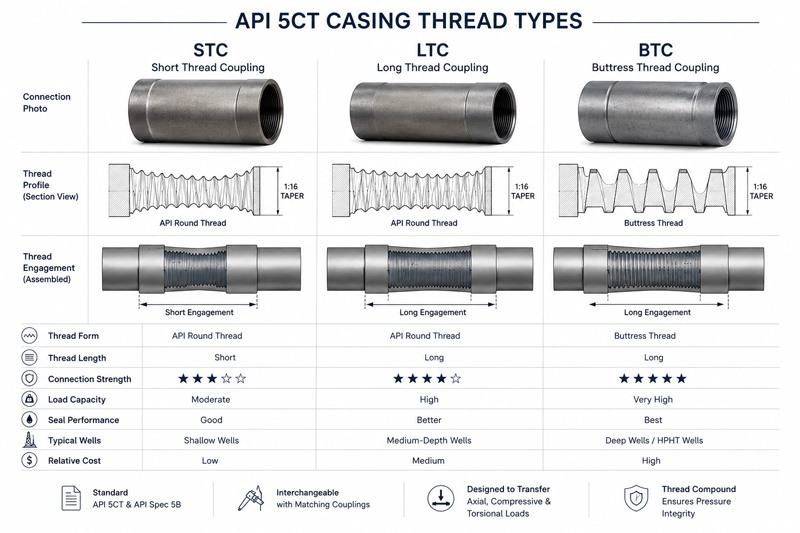
The following table summarizes the main differences between these three casing connections.
| Feature | STC | LTC | BTC |
| Full name | Short Thread and Coupling | Long Thread and Coupling | Buttress Thread and Coupling |
| Thread profile | Round | Round | Buttress |
| Typical thread pitch | 8 TPI | 8 TPI | 5 TPI for many standard sizes |
| Thread engagement | Shorter | Longer than STC | Buttress-specific geometry |
| Load-bearing characteristics | Depends on size and grade | Often greater tensile capacity than comparable STC | Designed for favorable axial load transfer |
| Sealing mechanism | Thread engagement and thread compound | Thread engagement and thread compound | Thread engagement and thread compound |
| Typical selection factor | Specified load capacity and cost | Increased joint capacity relative to comparable STC | Axial loading and connection strength requirements |
Important: TPI means threads per inch. Thread pitch, geometry, and connection dimensions must be verified against the applicable standard and ordered product specification. The table describes general characteristics rather than guaranteed performance ratings.
5. What Is the Difference Between STC, LTC, and BTC Sealing Performance?
Sealing performance is an important consideration when selecting casing connections for oil and gas wells.
STC and LTC use round-thread designs. Their sealing performance depends on the specified thread geometry, correct make-up, and the use of appropriate thread compound.
BTC uses a buttress thread profile that provides favorable load-bearing characteristics. However, its thread form alone does not guarantee gas-tight performance under every operating condition.
For wells with demanding pressure requirements, gas-tight sealing requirements, or challenging thermal and mechanical cycles, operators may need a qualified premium connection with an appropriate metal-to-metal seal.
The correct selection depends on the required leakage acceptance criteria, pressure conditions, temperature, and applicable qualification or testing requirements.
6. How to Choose Between STC, LTC, and BTC Casing
Selecting a casing connection involves more than comparing thread lengths or counting threads per inch. The following factors should be evaluated.
6.1 Well Depth and Axial Loads
Determine the expected axial loads on the casing string, including the effects of the casing’s suspended weight and relevant operating conditions.
Where connection tensile capacity is critical, compare the rated joint strength of the available STC, LTC, and BTC options.
6.2 Pipe Size and Steel Grade
The same connection designation does not guarantee the same load capacity across different casing sizes and steel grades.
Confirm the following information before ordering:
- Casing outside diameter.
- Nominal pipe weight or wall thickness.
- Steel grade, such as J55, K55, N80, L80, or P110.
- Connection type and applicable dimensions.
- Required joint performance ratings.
6.3 Pressure and Sealing Requirements
Evaluate internal pressure, external pressure, expected temperature, and the required leakage performance.
If the application requires qualified gas-tight performance, verify whether a standard API connection meets the design requirements or whether a suitable premium connection is necessary.
6.4 Installation and Make-Up
Proper installation is essential for connection reliability. Thread condition, cleanliness, compound selection, make-up procedures, and applicable torque or acceptance criteria must be controlled.
Thread inspection and gauging should follow the applicable API requirements and the manufacturer’s documented procedures.
6.5 Standards and Quality Documentation
API Specification 5CT addresses casing and tubing product requirements, including dimensions, material grades, and applicable end finishes. API Specification 5B addresses casing and tubing thread manufacturing, gauging, and inspection requirements.
Always verify the applicable editions, amendments, product specification, and
Conclusion
STC, LTC, and BTC are three widely recognized casing connection types used in oil and gas well construction.
STC features a short round-thread design, LTC provides longer round-thread engagement, and BTC uses a buttress thread profile suited to applications requiring favorable axial load-bearing characteristics.
Choosing the right connection requires consideration of pipe size, steel grade, connection strength, pressure and sealing requirements, installation conditions, and applicable standards.
For casing procurement, always confirm the complete technical specification before ordering to ensure compatibility with the well design and operating conditions.
Looking for API 5CT casing and coupling solutions? Contact our technical team with your required casing size, steel grade, connection type, and quantity to discuss suitable product options.