


AREMA flat-bottom rails 115RE and 136RE are two widely used rail profiles in North America, Latin America, Africa and global mining & port railway projects. They follow AREMA Chapter 4 and ASTM A1 requirements, and are frequently specified in tender documents for freight lines, industrial sidings, mine haulage and container yard tracks.
Many buyers, civil contractors and track engineers struggle to decide which profile fits their project. Although both belong to the AREMA RE rail family, they have different geometric profiles, section moduli, load capacity and maintenance economics. 115RE and 136RE are NOT interchangeable. Fishplates, fasteners, base plates and rail pads are profile-specific.
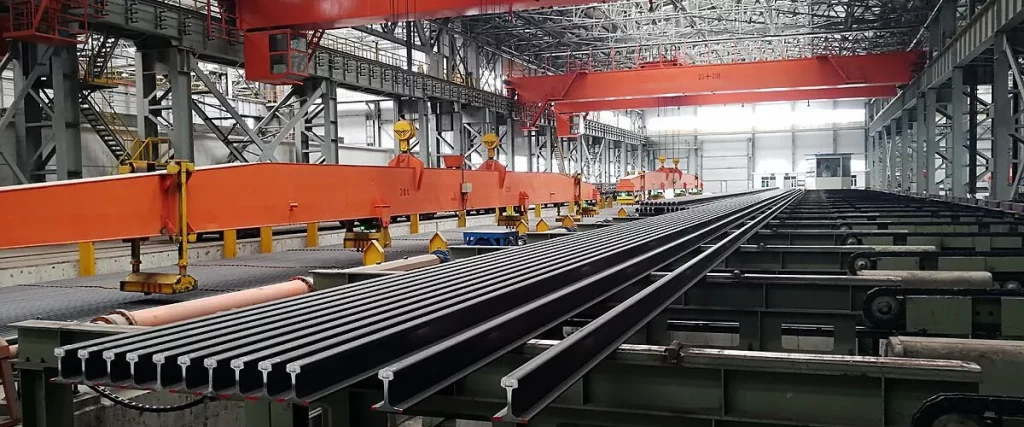
What Do 115RE and 136RE Stand For?
RE = Rail, American flat-bottom rail profile.
- 115RE: 115 lb/yd nominal weight, approximately 56.9 kg/m
- 136RE: 136 lb/yd nominal weight, approximately 67.5 kg/m
Important note: Do not confuse AREMA RE rail with European 60E1 (UIC60) or Chinese P60 rail. Different profile geometry, different tolerance systems and incompatible wheel-rail contact.
Core Dimension Comparison
| Item | AREMA 115RE | AREMA 136RE |
| Nominal weight | 115 lb/yd (56.9 kg/m) | 136 lb/yd (67.5 kg/m) |
| Rail height | 168.27 mm | 185.70 mm |
| Rail head width | 69.85 mm | 74.61 mm |
| Rail base width | 139.70 mm (5.5 inch) | 152.40 mm (6.0 inch) |
| Section modulus | Lower | Higher |
| Standard length | 12 m / 25 m | 12 m / 25 m |
Steel Grades & Mechanical Properties
AREMA rails are available in three mainstream grades for both profiles: Standard Carbon (900A), Intermediate Strength (1100) and Head Hardened (HH / 1200 /1300). Head-hardened rail is the preferred option for curves, braking zones and high wear locations.
| Grade | Tensile Strength | Hardness | Typical Use |
| 900A Standard Carbon | ≥983 MPa | Min 310 HBW | Gen sidings, low-medium traffic |
| 1100 Intermediate | ≥1138 MPa | 330–360 HBW | Mixed passenger & freight |
| 1200 /1300 HH Head Hardened | ≥1179 MPa | Min 370 HBW | Heavy haul, tight curves, mines, ports |
Chemical composition (wt%, common for AREMA rail): C: 0.69–0.86%, Mn:0.70–1.25%, Si:0.10–0.60%, P≤0.020%, S≤0.020%
HH rail only receives accelerated cooling on the rail head, not full-section quenching. It delivers excellent wear resistance and rolling contact fatigue (RCF) performance, similar to EN R350HT but under separate AREMA acceptance criteria. AREMA HH cannot be directly substituted for R350HT in EN tenders.
Application & Axle Load Guidance
115RE Rail
- Suitable axle load: Up to 25–30 t
- Typical scenarios: Regional freight lines, commuter passenger lines, industrial sidings, medium-volume mine tracks, port internal transfer lines
- Advantages: Lower initial investment, mature fastener supply, easier handling and transportation
- Limitation: Not recommended for continuous heavy axle loads or ultra-high tonnage routes; bending fatigue risk rises under long-term heavy haul
136RE Rail
- Suitable axle load: 30 t and above, Class I heavy haul lines
- Typical scenarios: High-volume ore & coal haulage, main freight trunk lines, large container terminals, high-tonnage long-term projects
- Advantages: Larger section modulus, higher stiffness, less deflection, better fatigue resistance, longer service life, lower life-cycle maintenance cost
- Limitation: Higher material cost, heavier lifting & installation work, dedicated fishplates and fastening system required
Welding & Inspection Requirements
Both 115RE and 136RE support flash butt welding and aluminothermic welding for CWR continuous welded rail.
- Standard inspection package: UT ultrasonic testing, dimensional check, straightness control, surface visual inspection, hardness sampling and tensile test.
- Mill Test Certificate (MTC) is mandatory for most international tenders; 3.1 certificate is widely requested.
- Special reminder: HH head-hardened rail requires qualified welding procedure specification to avoid rail head softening at weld joints.
115RE vs 136RE: Quick Selection Checklist
Choose 115RE if:
- Axle load ≤30 t
- Medium traffic, mixed passenger and freight
- Budget-sensitive siding, branch line or temporary track
- Replacement project originally built with 115RE fasteners
Choose 136RE if:
- Axle load >30 t, heavy haul main line
- High annual gross tonnage, ore/coal mining railway
- Long-term design life, priority on reducing track maintenance
- New build Class I freight corridor or large port main track
Conclusion
115RE and 136RE are both trusted AREMA rail solutions, but they serve different load tiers. 115RE balances cost and performance for medium-load tracks, while 136RE is the premium heavy-haul profile for high axle loads and high tonnage. When preparing tender quotations or technical proposals, confirm axle load, annual tonnage, curve radius and existing fastener system before finalizing rail profile and grade. Selecting the correct rail grade (standard carbon or HH head-hardened) is equally critical for long-term track reliability.